
The dialogue between believers and non-believers is no longer just a pastoral or philosophical exercise. Since the inclusion of Article 17 of the Treaty on the Functioning of the European Union, this dialogue has become an institutional obligation: European institutions must maintain an “open, transparent, and regular” exchange with Churches, religious associations, and philosophical and non-confessional organizations.
The question is no longer whether this dialogue is desirable, but rather to understand why its technical modalities condition its success.
Article 17 TFEU: the legal framework for dialogue between beliefs
Article 17 of the Treaty on the Functioning of the European Union structures the dialogue into three distinct paragraphs. The first two protect the status of Churches and philosophical organizations as defined by the national law of each member state. The third paragraph imposes on Union institutions an open, transparent, and regular dialogue with these actors.
This provision has a direct consequence: non-confessional organizations have formal representation. Humanists International, for example, is recognized as a partner in this institutional framework, which places humanist and atheist voices on an equal procedural footing with religious actors. We observe a shift from historical consultation formats, which were long reserved for established confessions.
The European Commission has resumed its high-level meetings with religious, philosophical, and non-confessional organizations after the interruption due to the pandemic. This restart confirms that dialogue is an institutional tool for democratic cohesion, not just a symbolic gesture. Initiatives like those documented on parvisdesgentils.fr illustrate this dynamic of structured encounters between believers and non-believers, a direct heir to the desire to open common spaces for dialogue.

Dialogue and French secularism: an overlooked procedural obligation
In France, the dialogue between beliefs is not confined to the sphere of voluntary associations. It now has a binding legal dimension in certain contexts.
The Council of State confirmed, in its decision n° 487944 of September 27, 2024, that a dialogue with the student must precede any disciplinary procedure related to the wearing of religious signs or attire in a public institution. This procedural requirement particularly concerns situations related to the abaya or the qamis.
The scope of this decision goes beyond school law. It establishes a principle: the meeting between divergent beliefs can constitute a legally required step before any coercive measure. French secularism, often presented as a framework of strict separation, actually incorporates mechanisms for mandatory dialogue.
What this jurisprudence changes for field actors
For school leaders and educational teams, this decision requires documenting the dialogue phase. A failure in this step can lead to the annulment of the sanction by the administrative judge. The meeting is no longer a pedagogical recommendation; it is a condition of legality for the disciplinary procedure.
This legal framework aligns with a broader concern: in the face of the growing polarization of debates on religion in the French public space, structured dialogue mechanisms become instruments of social regulation, not just spaces for spiritual exchange.
Polarization and radicalization: what dialogue concretely prevents
We recommend distinguishing two functions of the dialogue between believers and non-believers, often confused in public debate:
- The function of preventing radicalization, which targets processes of cognitive confinement and community isolation. Dialogue creates points of contact that make it more difficult to construct a discourse of total rupture with society.
- The function of building a common culture of disagreement, which allows participants to maintain their convictions while accepting the legitimacy of opposing beliefs. This skill is distinct from passive tolerance: it requires active learning.
- The function of democratic representation, documented by the European framework of Article 17 TFEU, which ensures that political decisions incorporate the real diversity of worldviews present in the population.
These three functions mutually reinforce each other. A dialogue that fulfills only one of these functions produces fragile results.
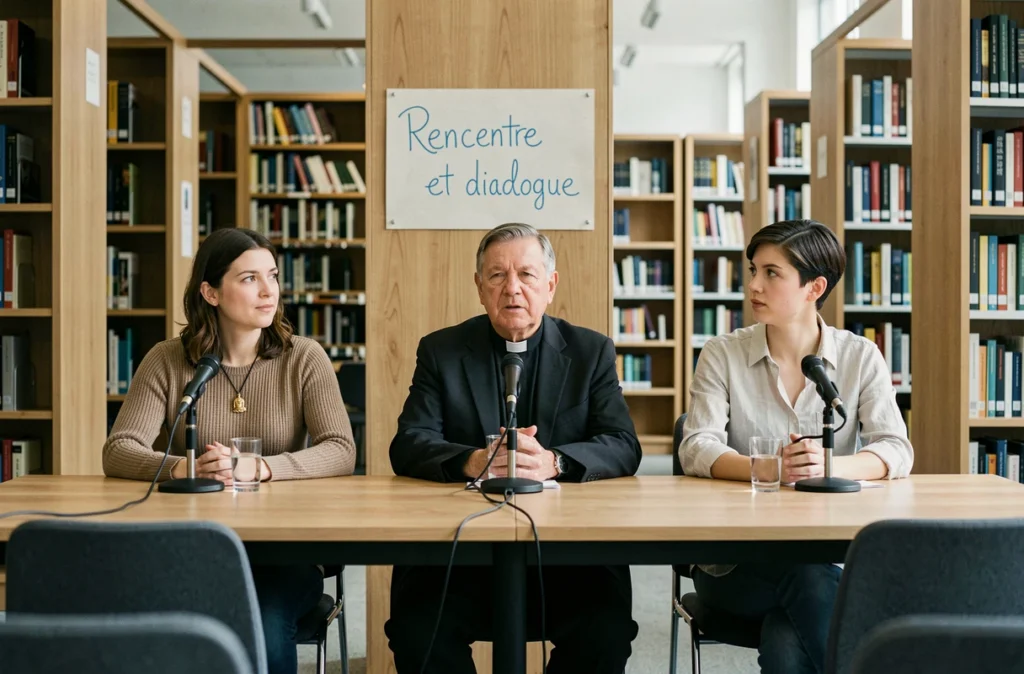
Theology and non-confessional organizations: a common vocabulary to build
The main technical obstacle to dialogue between believers and non-believers remains the disparity of conceptual frameworks. Christian theology, Islamic thought, and humanist philosophy do not share the same assumptions about the nature of truth, the status of reason, or the purpose of communal life.
This disparity is not an argument against dialogue. It defines the conditions for success. A productive exchange assumes that participants identify their procedural points of agreement (how to dialogue) before addressing substantial points of disagreement (what to dialogue about).
Interreligious and interconvictional skills
The notion of interreligious competence has expanded to include the ability to dialogue with non-religious interlocutors. This evolution reflects the actual composition of society: non-believers represent a significant part of the European population, and their absence from dialogue spaces skews exchanges.
The recognition of Humanists International as a European institutional partner marks a turning point. It means that faith and absence of faith are treated as equally legitimate positions in public debate. For religious actors, this institutional symmetry constitutes both a challenge and an opportunity: dialogue gains credibility when it includes those who do not share the premise of the existence of God.
The dialogue between believers and non-believers does not need additional moral justification. Its European legal framework, its procedural dimension in French law, and its role in preventing polarization make it a concrete, measurable mechanism, the absence of which produces documented effects. Refusing dialogue does not protect any belief; it weakens them all.