A living soil doesn’t come from a bag of potting mix and daily watering. Natural gardening relies on precise biological processes, from the mycorrhizal network to beneficial wildlife, as well as a careful understanding of local regulations, particularly those governing water use. What sets a resilient garden apart from one that depends on constant support is the soil’s ability to function without synthetic inputs or permanent irrigation.
Watering restrictions and natural gardening: what local regulations really change
Watering restrictions don’t follow a single nationwide rule. They depend on the geographical area, the water resource concerned and the local order in force. Gardeners should check the rules that apply to their address rather than rely on a general rule about watering times.
First misconception to clear up: vegetable gardens are not automatically exempt from drought restrictions. Depending on local measures, watering may be limited or prohibited even for food crops. Check the applicable order and any exceptions before assuming your vegetable garden is exempt.
Another point that is often misunderstood: drip irrigation does not, by itself, grant an exemption. The watering method, whether manual or targeted, is not enough. Local regulations determine which uses are permitted, which water sources may be used and during what hours. These rules can change during the season, especially during a drought.
We’ve found that managing water in the garden starts with regularly checking local orders, not just installing a water-efficient system. These regulations provide the foundation for growing practices that reduce reliance on watering.
Resources such as Jardiner Naturellement help gardeners combine ecological gardening practices with real-world conditions, including restrictions on water use.
Living soil and the mycorrhizal network: reducing water needs at the source
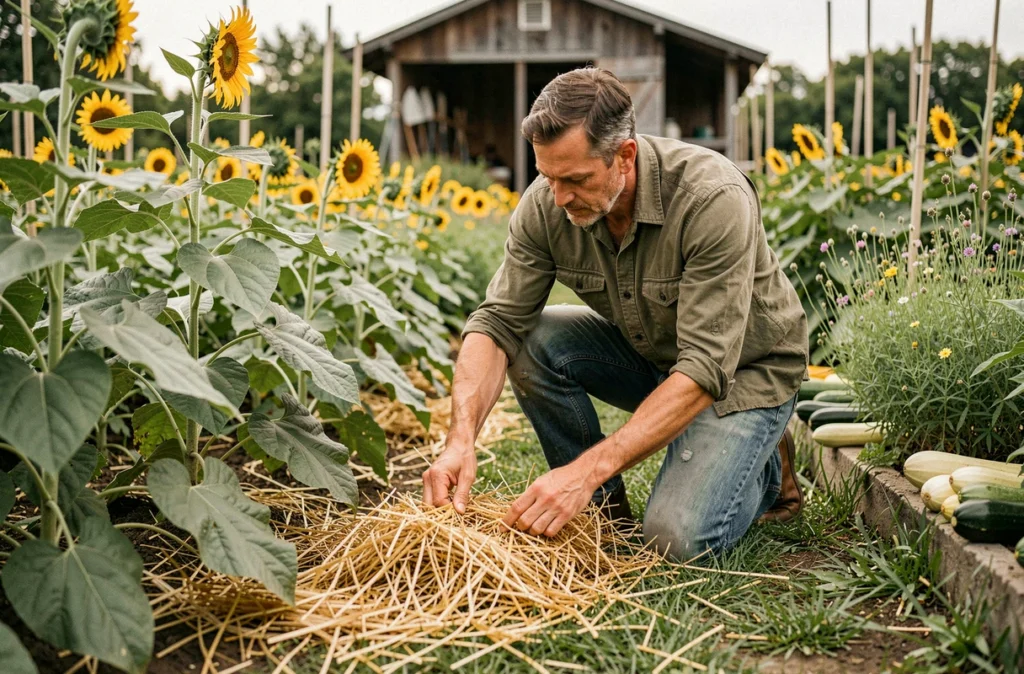
Biologically active soil retains more water than compacted or depleted soil. Organic matter and microbial life are key. A permanent organic mulch (fallen leaves, wood chips, straw) retains moisture, feeds soil fauna and protects soil structure from compaction caused by rain.
The mycorrhizal network extends the root zone’s reach far beyond the roots themselves. These symbiotic fungi colonize the soil’s micropores and transfer water and minerals to host plants. Deep tilling or applying synthetic fungicides destroys this network, leaving plants more vulnerable to water stress.
To protect this soil life:
- Limit soil disturbance to lightly scratching the top five centimeters without turning the soil over.
- Keep the soil covered with plants or mulch throughout the year to prevent bare ground, which crusts over and loses its porosity.
- Avoid all synthetic pesticides, including residual herbicides, which can sterilize fungal life for several weeks.
- Apply mature compost to the surface rather than burying it, feeding the upper soil layers without disturbing the biological layers already in place.
Soil structured in this way absorbs heavy rain without runoff and releases water gradually. The difference between mulched and bare soil after a week without rain is plain to see: the former still feels cool to the touch, while the latter cracks.
Beneficial wildlife and native plants: a balance that replaces treatments
Beneficial insects naturally keep pests in check when the garden provides food and shelter throughout the year. Lacewings, hoverflies, ground beetles and rove beetles eat large numbers of aphids, slugs and larvae, provided they have places to shelter.
A decaying woodpile, an unmown strip of vegetation or an informal hedge made up of native species: these features aren’t just decorative. They form the garden’s ecological infrastructure. Without them, pest pressure increases and the temptation to use pesticides returns.
Plant selection matters just as much as garden design. Varieties suited to the local climate need less water and are more resistant to disease. Growing a Mediterranean species in an oceanic climate, or the other way around, creates an artificial dependence on watering and treatments. Native plants also attract local pollinators, which are already adapted to their flower shapes and blooming seasons.
Companion planting in the vegetable garden reinforces this approach. Some plants repel specific pests through their volatile compounds. Others, such as legumes, fix atmospheric nitrogen in the soil and reduce the need for fertilizer for neighboring crops.
Composting and green manures: closing the nutrient loop without inputs
Home composting turns kitchen and garden waste into an amendment rich in microorganisms. Mature compost, dark brown and smelling of woodland, improves both soil structure and fertility. A well-managed compost pile reaches a high enough temperature to destroy weed seeds and pathogens.
Green manures complete the cycle. Sown between crops (phacelia, mustard, clover), they cover the soil, capture nutrients that would otherwise leach away and return them to the next crop when worked lightly into the surface. Their roots loosen the soil at depth without mechanical intervention.
Together, these two practices make it possible to do without synthetic mineral fertilizers altogether. The garden then works in a loop: it produces its own fertility, supports its own natural pest control and uses less water thanks to well-structured, covered soil.
Natural gardening doesn’t mean sacrificing yield or beauty. It means changing the technical approach: instead of compensating for deficiencies in a depleted system, we build an ecosystem that regulates itself. The first sign of success isn’t the size of the tomatoes, but the number of earthworms in a spadeful of soil.