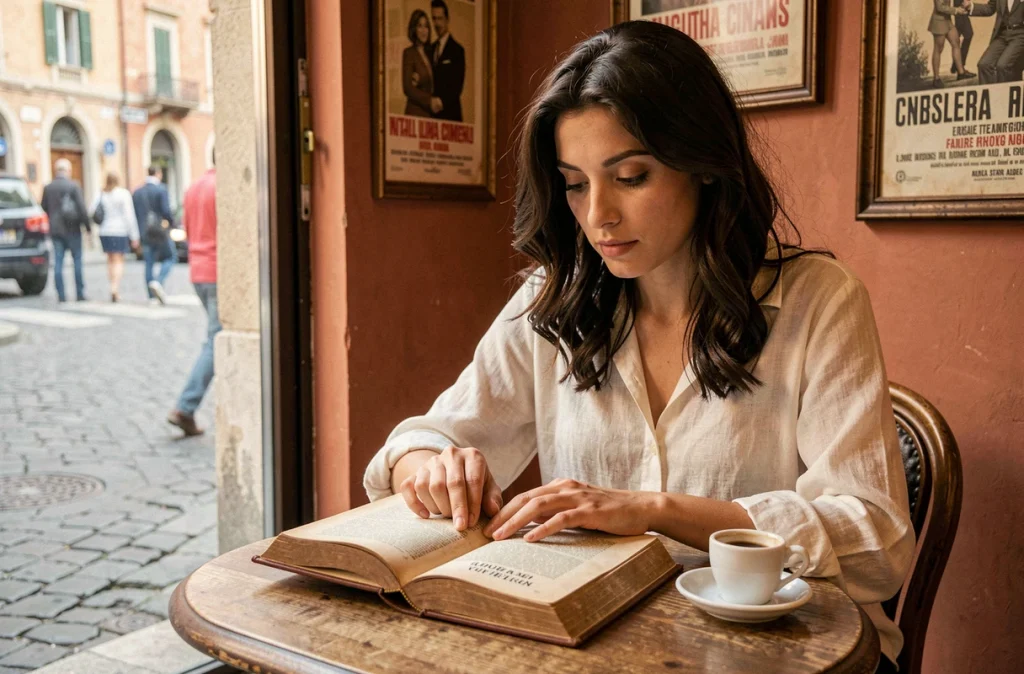
Some Italian first names owe their popularity outside of Italy not to tradition, but to a fictional character. A significant role in a film or series can sometimes propel a rare name into the civil registries of all of Europe. Here is a selection of twenty Italian names directly linked to cinema and cult series, along with what distinguishes them etymologically and culturally.
Italian male names carried by movie characters
Italian and Italian-American cinema has propelled several names well beyond their area of origin. Some remain attached to a unique character, to the point that carrying the name is akin to quoting the film.
Vito is inseparable from the godfather Vito Corleone. Derived from the Latin “vita” (life), this name was common in Southern Italy before Francis Ford Coppola gave it a worldwide cinematic connotation. Salvatore, borne by the protagonist of Cinema Paradiso, comes from the Latin “salvator” (savior) and remains very popular in Sicily.
Fredo, a diminutive of Alfredo, evokes the fragile brother of the Corleone saga. Alfredo himself appears in Cinema Paradiso as the projectionist who passes on his passion. Two films, two Alfredos with opposite trajectories. To explore other Italian names on Dididou, the intersection of etymology and fiction is detailed film by film.
Sonny (diminutive of Santino) and Antonio complete this male register. Antonio, the hero of Bicycle Thieves by Vittorio De Sica, carries a name of Latin origin (“Antonius”) that has been among the most given in Italy for centuries. The film gave it a universal dimension, that of the ordinary father facing injustice.

Italian female names revealed by the big screen
Cinema has also fixed in the collective imagination female names that fashion alone would not have sufficed to export.
Giulietta owes much to Federico Fellini and his film Giulietta degli spiriti (Juliet of the Spirits). The name existed before Shakespeare, but it is the Italian version, with its double “t,” that bears the mark of auteur cinema. Its etymology traces back to the Latin “Julius,” possibly linked to Jupiter.
Sofia directly refers to Sofia Loren, and then to Sofia Coppola. This Greek name meaning “wisdom” dominates recent Italian rankings, alongside Aurora, Ginevra, Vittoria, and Giulia. Its presence in cinema has reinforced an already solid popularity.
- Monica: associated with Monica Vitti, a figure of Italian comedy and muse of Michelangelo Antonioni. Uncertain origin, possibly linked to the Greek “monos” (alone) or the Latin “moneo” (to advise).
- Claudia: borne by Claudia Cardinale, this Latin name (“Claudius,” from the Roman family) has traversed decades thanks to Visconti’s The Leopard.
- Valentina: popularized by the Italian comic book character created by Guido Crepax before appearing in several film productions. From the Latin “valens” (strong).
Italian names from cult television series
Series have taken over from cinema in the dissemination of Italian names, sometimes with a more lasting effect because the characters accompany the audience over several seasons.
Gennaro and Lila (diminutive of Raffaella) owe their recent notoriety to L’Amie prodigieuse (My Brilliant Friend), adapted from the novels of Elena Ferrante. Gennaro, a Neapolitan name linked to the patron saint of Naples, was little known outside Italy before the series.
Ciro and Genny (diminutive of Gennaro) come from Gomorra, a series inspired by Roberto Saviano’s book. These names carry an ambivalent connotation: the fiction associates these names with organized crime in Naples, which may influence the perception of the name in certain cultural contexts.
Elena, the name of the narrator in L’Amie prodigieuse, comes from the Greek “helênê” (brightness of the sun). Already widespread in Italy, it gained international visibility thanks to the series. Imma, diminutive of Immacolata, appears in several Neapolitan productions and remains rare in France.

Fictional Italian name and traditional Italian name: a distinction to know
An often overlooked angle in name lists concerns the difference between a name truly of Italian origin and a name simply perceived as Italian due to its sound. Several lists mix authentically Italian forms with international variants.
Thus, Nino (used in several neorealist films) is indeed an Italian diminutive of Antonino. In contrast, a name like Stella, sometimes classified as Italian, is actually commonly used in many languages without specific ties to Italy.
Names derived from Roman antiquity or the Renaissance, such as Vittoria, Lorenzo, or Beatrice, have documented etymological lineage. Those that owe their “Italianity” solely to a film character deserve to be identified as such to avoid cultural misunderstandings.
Four names with dual readings
- Matteo: a biblical name (from the Hebrew “gift of God”), very popular in Italy, also popularized by contemporary Italian cinema.
- Luca: of Greek origin (“Loukas,” native of Lucania), carried by the Pixar animated film that introduced it to a global child audience.
- Enzo: diminutive of Lorenzo or Vincenzo, associated with director Enzo G. Castellari and the world of car racing (Enzo Ferrari).
- Rosa: a Latin name linked to the flower, present in Italian neorealism and in several recent Neapolitan series.
The choice of an Italian name linked to fiction engages a dual reading. The name carries both its own etymology and the memory of the character. For names like Vito or Ciro, this fictional memory weighs heavily. For others like Sofia or Elena, the cultural reference enriches a name already firmly rooted in Italian tradition without altering its perception.