The “6-star” category does not exist in any official reference. No ISO standard, no national decree recognizes this level. Establishments that claim this distinction do so based on self-proclamation, sometimes validated by local rankings (Dubai, Vietnam), sometimes by a simple market consensus. Understanding this mechanism is a prerequisite before comparing addresses.
Technical criteria that separate a 5-star palace from a self-proclaimed 6-star hotel
In France, the “palace” label already distinguishes the most accomplished 5-star hotels based on specific criteria: remarkable location, architectural quality, enhanced concierge services, high staff-to-guest ratio. A self-proclaimed 6-star hotel pushes each of these sliders significantly further.
We observe three recurring markers among establishments that claim this status:
- A staff-to-room ratio greater than 5:1, compared to about 2:1 in a classic 5-star hotel, with a dedicated butler assigned per suite.
- An oversized land footprint relative to the number of keys: some resorts only operate about fifteen villas on an entire island, resulting in almost zero guest density.
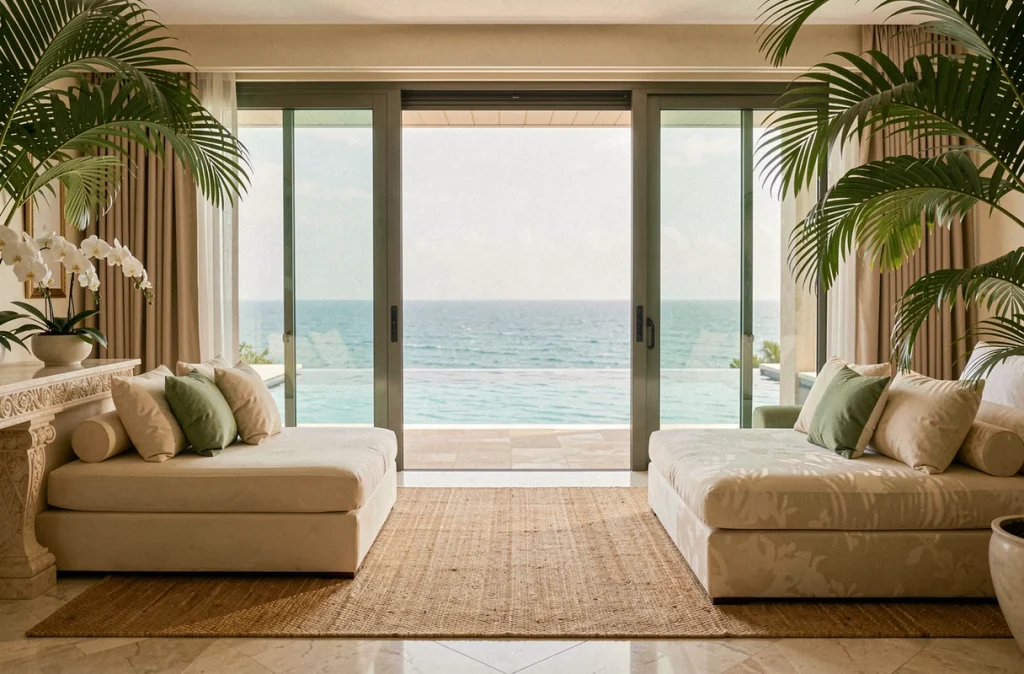
- Non-shared facilities: private pool per villa, spa access without reservation, seaplane or helicopter transfers included in the nightly rate.
This last point makes the most tangible difference. In a Parisian palace, the spa remains a shared space. In a resort claiming 6 stars in the Maldives or Seychelles, each villa operates as an autonomous hotel.
Among the 6-star hotels to discover, the Burj Al Arab Jumeirah in Dubai remains the historical reference. Its sail-shaped architecture, duplex suites, and eight restaurants set the standards for the segment as early as the late 1990s.

Seychelles and private islands: the new geography of extreme luxury
The “private island luxury” segment is experiencing marked acceleration in the Seychelles. Cheval Blanc has opened on Mahé, Waldorf Astoria is preparing to establish itself on Platte Island, and Fregate Island is announcing a reopening with only 14 villas. This concentration of investments in the same archipelago is not insignificant.
The logic is both industrial and aesthetic. A private island eliminates the problem of cohabitation with other clientele. The resort controls the entirety of the sound, visual, and ecological environment. For the traveler, this translates into a complete absence of queues, external noise, or compromises on the use of common areas.
We also recommend keeping an eye on openings outside the Seychelles. Several private island resorts are positioning themselves in Fiji, Indonesia, and the Caribbean, with integrated conservation models where part of the rate directly finances the protection of local biodiversity. Bawah Reserve in Indonesia, for example, has been recognized for its sustainability model.
Sustainability and conservation: the new criterion of high-end hotel luxury
The definition of 6 stars is evolving. Ostentation is receding in favor of a positioning centered on environmental conservation. Some very high-level resorts are now recognized for their ecological mission as much as for their services.
This shift is not cosmetic. Ultra-high-end luxury integrates sustainability as a standard of service, not as an ancillary marketing argument. In practical terms, this translates into autonomous desalination stations, on-site vegetable farms, closed-loop waste management, and species reintroduction programs.
For the discerning traveler, this criterion becomes a selection filter as crucial as the size of the suite or the number of restaurants. A resort that destroys its coral reef to install a dock can no longer claim to be in the highest segment, regardless of the quality of its butler service.
6-star adult hotels: the rise of child-free resorts
The “adult-only” trend is restructuring the high end of the market. In 2026, dozens of resorts exclusively reserved for adults opened in Saudi Arabia, Santorini, Mexico, and the Caribbean. This segmentation responds to a growing demand from clientele who consider absolute tranquility a non-negotiable luxury criterion.
The impact on the experience is direct. An adult-only resort can design its spaces without child safety constraints, with infinity pools without barriers, bars integrated into swimming areas, and sound programming in the evening. Architectural design gains freedom, and dining hours become more flexible.
For establishments aiming for the 6-star positioning, this format represents a powerful differentiation lever against family-friendly luxury resorts like One&Only or Four Seasons.
Choosing a 6-star hotel: questions the experienced traveler should ask
Since the label is not standardized, the burden of verification falls on the client. Before booking, three questions help distinguish a true exceptional hotel from a 5-star that inflates its communication:
- What is the exact number of keys and the staff-to-guest ratio? An establishment that refuses to communicate this figure probably has nothing exceptional at this level.
- Are transfers, the spa, and activities included or charged extra? In a true 6-star hotel, the nightly rate covers almost all services.
- Does the establishment have a verifiable environmental program (certification, annual report, NGO partnership)? The absence of transparency on this point is a weak but telling signal.
The extreme luxury market remains opaque by nature. The absence of official classification protects both the best establishments and benefits the less scrupulous ones. The only reliable filter remains the granularity of the questions asked before booking, and the resort’s ability to answer them without evasion.