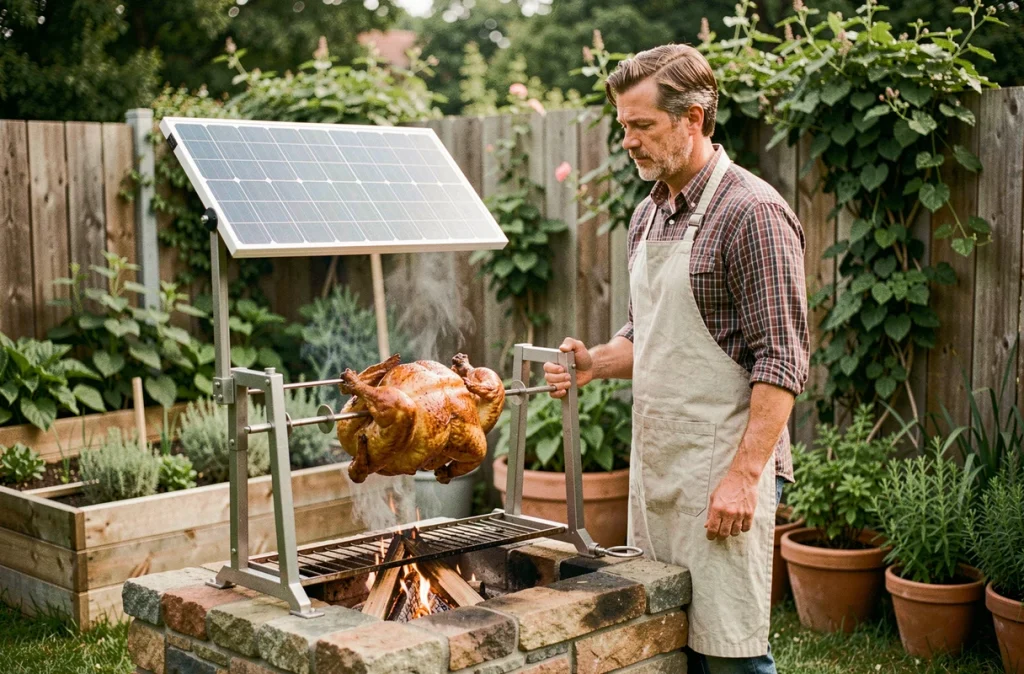
Grilling a piece of meat or vegetables in the sun, without charcoal or gas, still seems surprising. However, the solar rotisserie turns this idea into a very concrete reality. This device concentrates sunlight to produce enough heat for cooking, without any combustion. For those who want to organize an eco-friendly barbecue in their garden, it’s a sober and effective option.
Solar Cooking and Regulations: Why Charcoal is a Problem
Have you noticed that prefectural orders banning barbecues are multiplying during periods of drought? Every summer, French municipalities restrict or prohibit open fires in public spaces and sometimes even in private gardens to limit the risk of fire.
This tightening does not only affect France. In the United Kingdom, disposable barbecues are increasingly restricted in parks and natural areas. The European directive on air quality, which is set to be transposed by the end of 2026, strengthens the monitoring of domestic combustion sources, including charcoal grills.
The general market trend goes in the same direction: recent analyses of the sector highlight a rise in demand for electric grills and smoke-free alternatives in Europe, driven by regulatory constraints and neighborhood issues related to smoke. A solar rotisserie fits into this dynamic, as it eliminates smoke, particles, and fuel. No risk of embers, no persistent odor on the neighbor’s laundry.
To explore this approach, Energie O’ Solr’s solar solutions show how a solar cooking device can replace a traditional barbecue in daily life.
Solar Rotisserie: How Cooking Without Fire Works
The principle is based on concentrating solar radiation. A parabolic reflector (often made of polished aluminum or covered with a mirror film) captures sunlight and redirects it to a precise focal point. It is at this point that the spit rotates, exposing the meat or food to intense heat.
In practical terms, the mechanism breaks down into three steps:
- The parabolic reflector directs the rays toward a central point. The larger the diameter of the reflector, the greater the capture area, and the higher the temperature at the focal point.
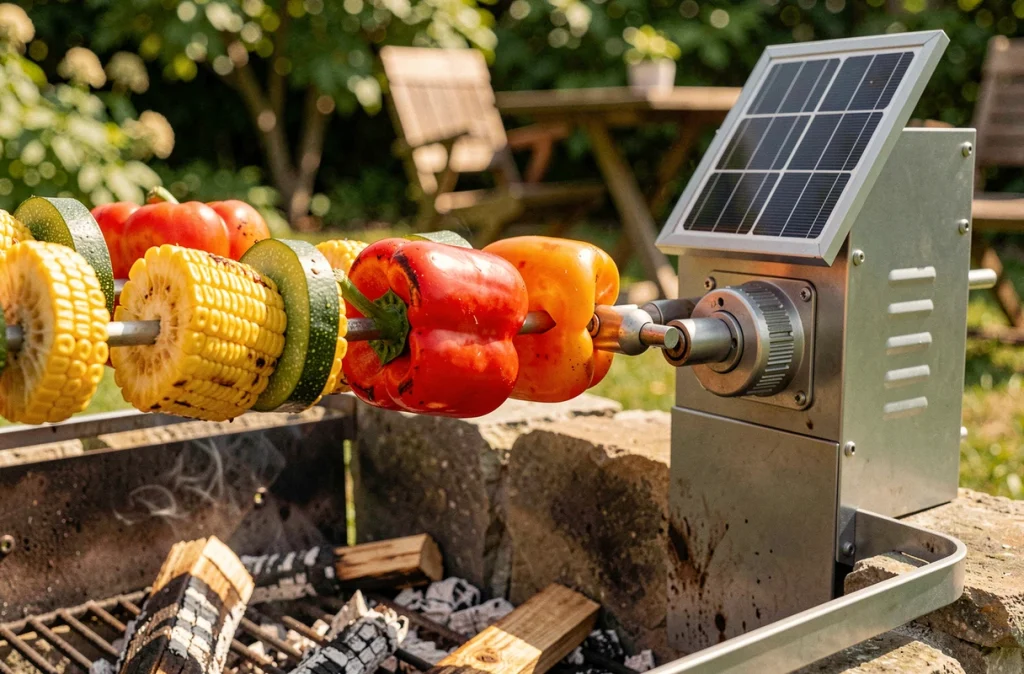
- A spit support, placed at the focal point, keeps the food rotating slowly. This regular rotation ensures even cooking, just like a traditional rotisserie.
- A small motor (often powered by an integrated photovoltaic panel or a battery) turns the spit without manual intervention.
High-quality solar parabolas reach temperatures comparable to those of a gas barbecue. The heat-up time takes a few minutes longer than with charcoal, but the cooking remains stable as long as the sun is present.
Orientation and Adjustment of the Reflector
The reflector must remain oriented toward the sun. During a cooking session of one to two hours, it is necessary to readjust the angle once or twice to follow the sun’s path. Some models have a simplified tracking system, with a shadow marker indicating when to pivot the device.
This adjustment is the only real constraint. No charcoal to light, no grill to clean of charred grease, no bin full of ashes to empty.
Installing a Solar Rotisserie in a Garden: Concrete Criteria
A solar barbecue does not work just anywhere. Before investing, check three parameters that determine if your garden is suitable.
Direct sunlight is the non-negotiable condition. You need an open location, without shade from trees or buildings between 11 AM and 4 PM in summer. A partially shaded area significantly reduces power.
The required ground area depends on the model. A standard-sized parabolic reflector requires about one square meter, plus a safety perimeter of one meter around it (the focal point is burning). Ensure a stable and flat surface, such as a slab or compacted lawn.
Wind is an underestimated factor. A lightweight parabolic reflector can tip over in a gust. Models made of steel with a weighted base are more stable. If your garden is exposed, secure the device or choose a sheltered location.
Eco-Friendly Barbecue Daily: What Solar Cooking Changes
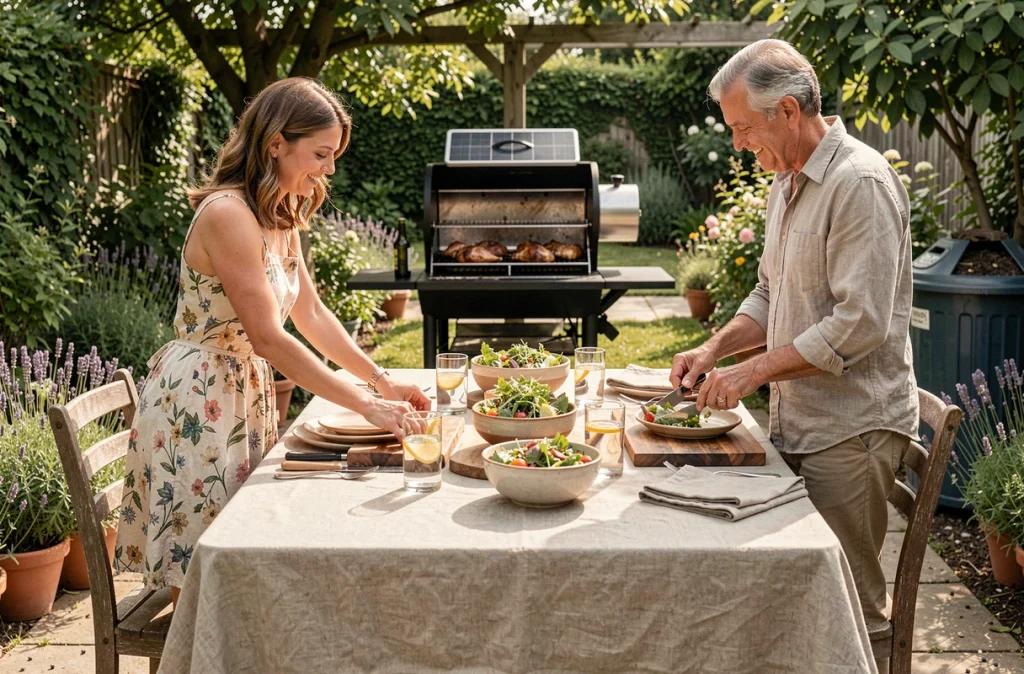
Switching from charcoal to solar changes a few habits. The first: you no longer cook at any hour. The optimal window is between late morning and mid-afternoon when the radiation is most direct. A late summer dinner is still possible until 6 PM-7 PM in mid-summer, but the power decreases.
The second: the choice of food adapts slightly. A solar rotisserie excels with pieces that require slow and rotating cooking (whole chicken, roast, ribs). For sausages or skewers, a grill placed at the focal point works, but the cooking surface is smaller than that of a traditional charcoal barbecue.
Maintenance and Durability
The absence of combustion radically simplifies maintenance. No ashes, no charcoal residues, no grill soiled by smoke. A simple wipe of the reflector with a soft cloth is enough to maintain its concentrating power. The spit can be washed like any kitchen utensil.
Removable models can be stored in a bag or garden chest off-season. Their lifespan mainly depends on the quality of the reflector: an anodized aluminum mirror withstands the elements well, while a sticky film may degrade after a few seasons.
Organizing an eco-friendly barbecue in your garden with a solar rotisserie requires adequate sunlight and a slight adjustment of cooking habits. In return, zero fuel, zero smoke, zero prefectural restrictions. For the upcoming summers, it’s a choice that becomes increasingly relevant as regulations on air quality and fire risks strengthen.