A child’s birthday party is based on a simple principle: the quality of the entertainment determines the memory that guests will keep of the celebration. Choosing between a live show, a participatory workshop, or a group game is not trivial. Each format caters to a different age group, available space, and level of interaction. Before browsing through provider catalogs, it’s best to understand what distinguishes these formats to make a choice suitable for the children present.
Live show or participatory workshop: two distinct entertainment logics
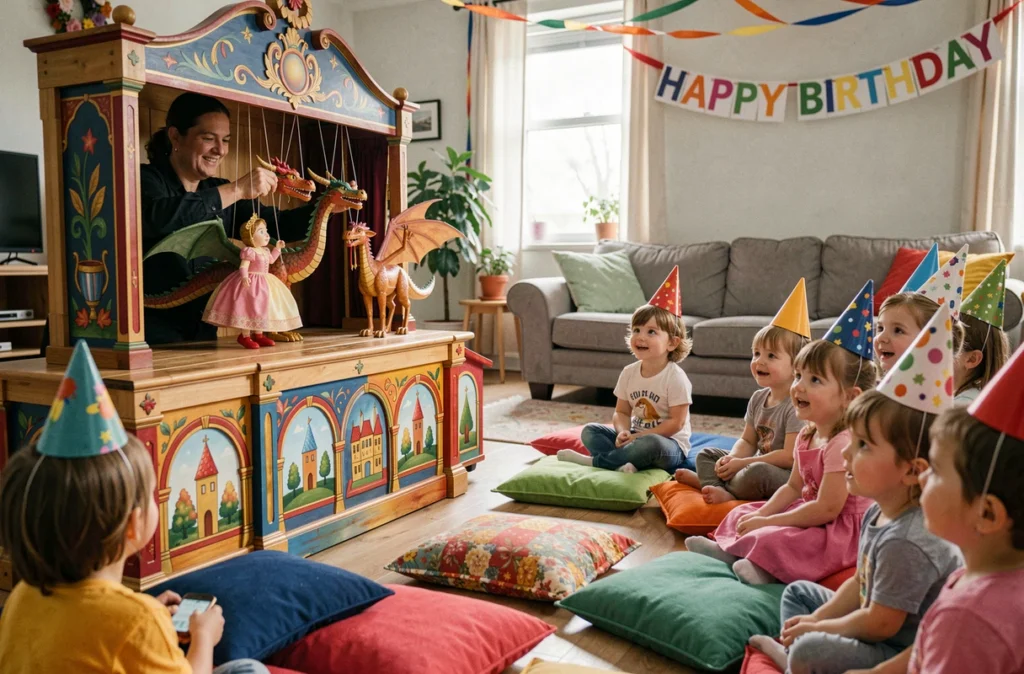
A children’s show (magic, puppetry, giant bubbles) places guests in the role of spectators. The artist manages the pace, captures attention, and structures the party time without parental intervention. This format works particularly well for groups of more than ten children, where channeling collective energy becomes a real challenge.
A participatory workshop (potion making, accessory crafting, canvas painting) reverses the dynamic. Each child produces something they take home. Individual engagement is stronger, but managing the group requires more adult supervision.
The choice mainly depends on the average age of the group. Before the age of six, a short, visual show (bubbles, puppets) captures attention better. Beyond that, children demand interaction, challenge, and even competition. At Le Petit Castor, there are formulas that combine both approaches to accommodate mixed-age groups.
Mixing the two formats at the same party remains the most reliable solution: a show phase to gather everyone upon arrival, followed by workshops in small groups for the second part of the afternoon.

Children’s birthday themes: what has changed since 2024
Classic themes (pirates, princesses, superheroes) have not disappeared, but they no longer dominate requests as they once did. Since 2024, specialized platforms like Kidsplanner have observed a clear shift towards themes related to digital culture among 7-12 year olds: K-Pop, TikTok, video games, content creators.
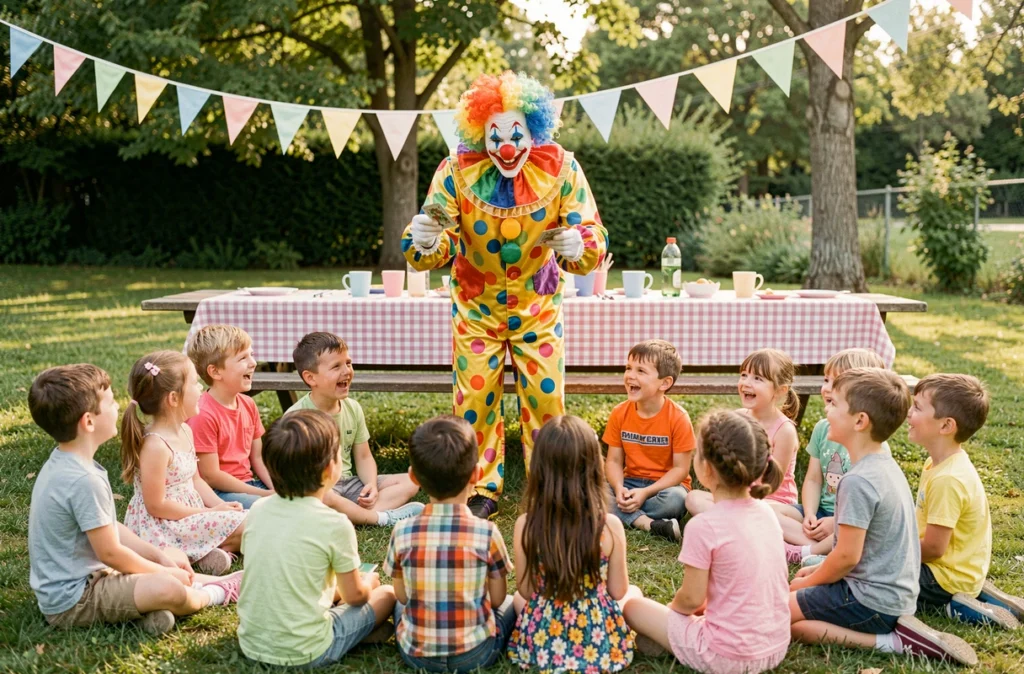
This change has a direct consequence on entertainment. A TikTok theme calls for a choreography workshop or a mini video studio, not a traditional clown show. A video game theme lends itself to timed obstacle courses or escape games, not a classic face painting session.
The little ones follow their own trend
For 3-6 year olds, the novelty comes from elsewhere. Since 2026, the capybara has become a sufficiently requested theme for dedicated decoration kits to appear on the market. This detail illustrates a fine diversification of animal universes offered to young children, beyond the usual unicorns and dinosaurs.
Aligning the entertainment with the chosen theme changes the perceived coherence of the party. A magician in a wizard costume for a Harry Potter birthday creates an immersion that the same magician in neutral attire will never achieve.
Home birthday entertainment: technical constraints to anticipate
The majority of children’s parties take place at home, and this factor imposes limits that parents often underestimate. Before booking a provider, three technical criteria deserve to be checked:
- The available floor space. A magic show requires a minimum distance between the artist and the front row of children for the illusions to work. A living room of less than fifteen square meters makes the performance uncomfortable for everyone.
- The acceptable noise level. An entertainer with sound equipment in a condominium apartment on a Saturday afternoon can generate neighborly tensions. Checking the building’s rules before booking avoids unpleasant surprises.
- Access to a water point and a protectable surface. Creative workshops (painting, slime making, potions) generate splashes. Without a tarp on the floor and quick access to a sink, post-party cleaning becomes a chore.
A garden or a covered terrace resolves most of these issues. For urban apartments, turnkey packages with equipment suitable for small spaces are available from some providers, but this must be specified when requesting a quote.
Interactive shows for children: formats that work according to age
Interactivity is the criterion that separates a successful entertainment experience from a moment when children disengage. The appropriate level of interaction varies significantly by age group.
From three to five years
Children in this age group react to what they see and touch. Giant bubble shows, where the artist traps a child in a bubble, or puppets with visible manipulation, produce a guaranteed effect. The ideal duration does not exceed thirty minutes: beyond that, attention drops sharply.
From six to nine years
This is the age group most receptive to mystery games, scripted treasure hunts, and portable escape games. These children want to solve, search, and collaborate. A good entertainer adapts the difficulty in real-time to avoid frustration without removing the challenge.
Ten years and older
Preteens shy away from anything that seems “for little kids.” Spectacular science workshops (visual chemical reactions, water rocket construction), circus arts introductions, or beatbox sessions work because they involve a skill to acquire, not just passive entertainment.
- Before six years: prioritize visual and sensory experiences (bubbles, puppets, face painting).
- From six to nine years: focus on investigation, cooperation, and challenges (treasure hunts, escape games).
- Ten years and older: offer concrete learning experiences (circus, science, beatbox, video creation).
The classic trap is to choose entertainment based on the trendy theme rather than the actual age of the guests. A brilliant escape game for eight-year-olds will become a fiasco for four-year-olds, regardless of the entertainer’s talent.
One last point to keep in mind: the total duration of the entertainment should not exceed half of the party time. Children need free moments to play among themselves, eat cake, and simply enjoy without imposed structure. A party that is too scheduled tires them as much as a party without any structure.