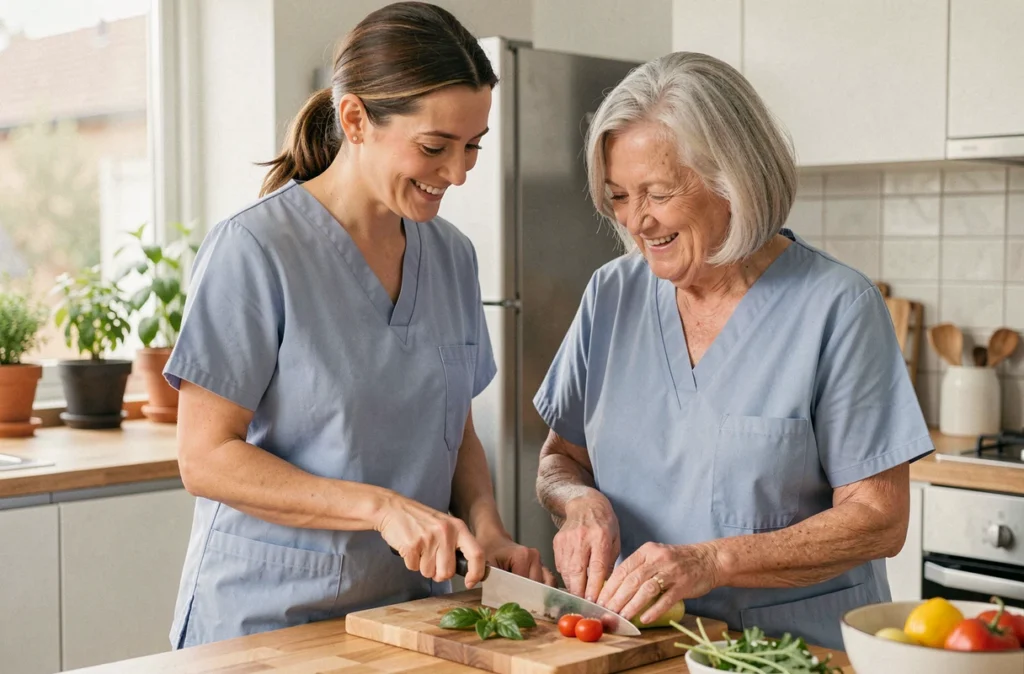
Home autonomy services, created to replace the old separation between SAAD, SSIAD, and SPASAD, are reshuffling the cards for senior support. Since 2023, this merger aims for tighter coordination between daily living assistance, nursing care, and guidance. We observe that this reorganization is changing the selection criteria for families and professionals in the sector.
Home autonomy services: what the SAAD-SSIAD merger changes
The old model segmented interventions. One assistance service managed shopping, cleaning, and meal preparation. A nursing service took care of medical acts. The senior or their family had to coordinate two distinct structures, with two contacts, two schedules, and two pricing logics.
Home autonomy services unify assistance and care under one structure. A single coordinator organizes the intervention plan. The caregiver who helps with getting up in the morning can report a skin issue to the nurse from the same service, without going through an external administrative circuit.
For professionals in the sector, the change concerns internal governance. The service manager must lead mixed teams (caregivers, nursing assistants, nurses) where they previously managed a single profession.
We recommend checking with the department if the chosen structure has indeed finalized its conversion, as not all former entities have completed the process yet. An updated mapping of services on Info Seniors allows you to identify the structures already operational in this new configuration.
Direct employment of a home caregiver: the end of an exemption that changes costs
Direct employment remains a common mode of intervention: the family recruits a caregiver themselves, via CESU or a mandating service. This mode offers more flexibility in choosing the caregiver and organizing schedules.
The exemption from employer contributions for private employers under 80 years old has ended. Only beneficiaries of APA, PCH, or individuals aged 80 and over retain this advantage. For a household aged 70 to 79 that is not an APA beneficiary, the actual hourly cost significantly increases.
The practical consequences are direct:
- A 72-year-old senior in GIR 5 or GIR 6, not eligible for APA, now bears the full employer contributions on hours of housekeeping or shopping assistance
- Using a service provider becomes cost-competitive for this age group, as provider rates already include charges
- Families that used direct employment for a relative aged 70 to 79 must recalculate the out-of-pocket expenses by incorporating the new contributions
We recommend systematically comparing the net hourly cost between direct employment and provider mode before renewing an existing employment contract.
Respite for caregivers: a pathway that is being structured at the regulatory level
Supporting a senior is not limited to interventions with the elderly person. Respite for caregivers is becoming a regulatory focus in its own right, distinct from the aid plan intended for the senior themselves.
The goal is to offer family caregivers planned relief solutions, not just in emergency or burnout situations. Daycare, temporary accommodation, intervention by a professional at home during the caregiver’s absence: these provisions exist, but access remains unequal across departments.
For social sector professionals, this structuring implies thinking about the support plan by systematically including a caregiver component. A trained substitute caregiver does not fulfill the same role as a traditional caregiver: they must be able to replicate the primary caregiver’s habits to limit the senior’s disorientation.
Decrease in beneficiaries of home assistance: what DREES data reveals
According to DREES, the number of beneficiaries of social home assistance for the elderly has decreased for the first time since 2020. This decline, observed in the 2025 data, contrasts with several years of continuous growth.
Several hypotheses are circulating in the sector. The end of the exemption from contributions for those under 80 may discourage some households from seeking declared assistance. The development of technological solutions (advanced teleassistance, fall detection sensors) may also delay entry into a human assistance pathway.
This decline raises questions about the adequacy between the service offer and the expectations of seniors. The support model relies less and less on the family alone, but professional substitutes must remain financially accessible so that this evolution does not lead to a renunciation of care.
Departmental pricing and transparency
Provider structures operating across multiple departments face heterogeneous pricing grids. The same meal assistance act can be valued differently depending on the funding department, complicating readability for families and management for autonomy services.
The cross-referencing of GIR level, chosen intervention mode, and departmental pricing policy remains the only reliable method to estimate a realistic out-of-pocket expense. Support from a social worker or a local information point avoids unpleasant surprises on the first bill.