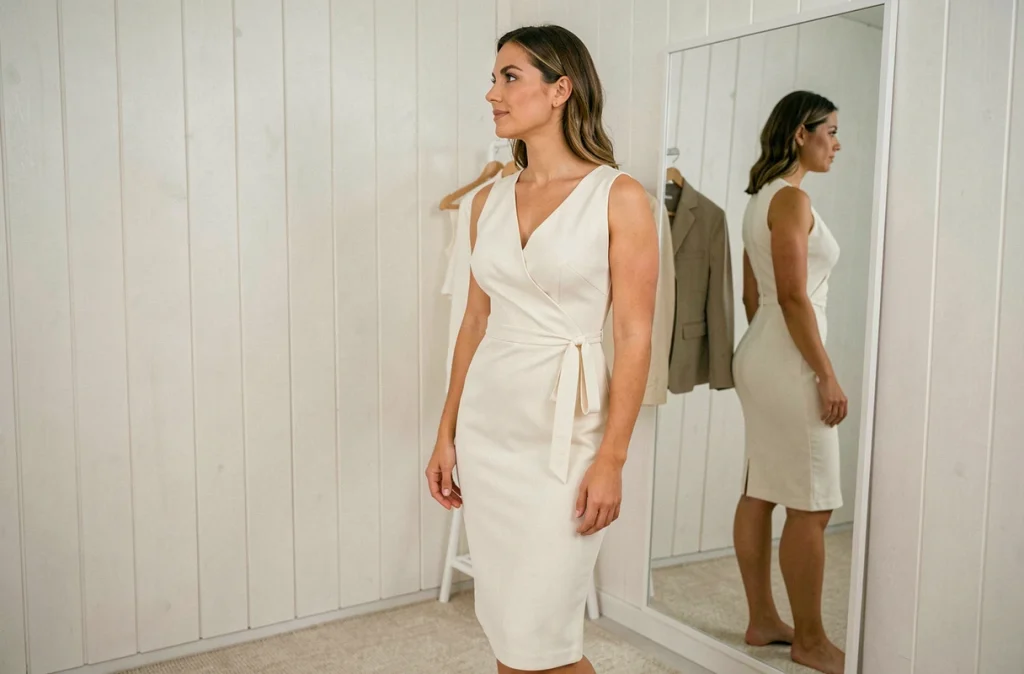
A French ready-to-wear size 38 refers to a standardized measurement chart, not a morphological goal. The confusion between clothing reference and body norm persists in most online guides. We will detail what this correspondence actually covers, the discrepancies between brands, and the thresholds that pertain to health rather than fashion.
Discrepancy between size charts and actual morphology for size 38
French manufacturers’ size charts place a size 38 around 68 to 70 cm waist circumference, with a bust measurement close to 88 cm and a hip measurement near 94 cm. These values are benchmarks for garment construction, calibrated for the cut of the clothing, not to qualify a silhouette.
The technical problem begins as soon as you compare two brands. A 38 at a fast-fashion retailer based on Asian sizing may correspond to a 36 at a classic European manufacturer. The reason lies in the measurement block of the basic pattern: each brand defines its own model, with ease allowances (values added to the body for comfort) that vary by several centimeters.
To place the ideal measurements for women’s size 38 in a reliable framework, we recommend always referring to the size guide specific to each brand rather than a universal chart.
In industrial pattern making, the grading between two consecutive sizes (from 36 to 38, then from 38 to 40) generally applies an increment of 4 cm on bust circumference, 3 cm on waist circumference, and 4 cm on hip circumference. These grading steps are not standardized by a single organization in France, which explains the variations from one brand to another.
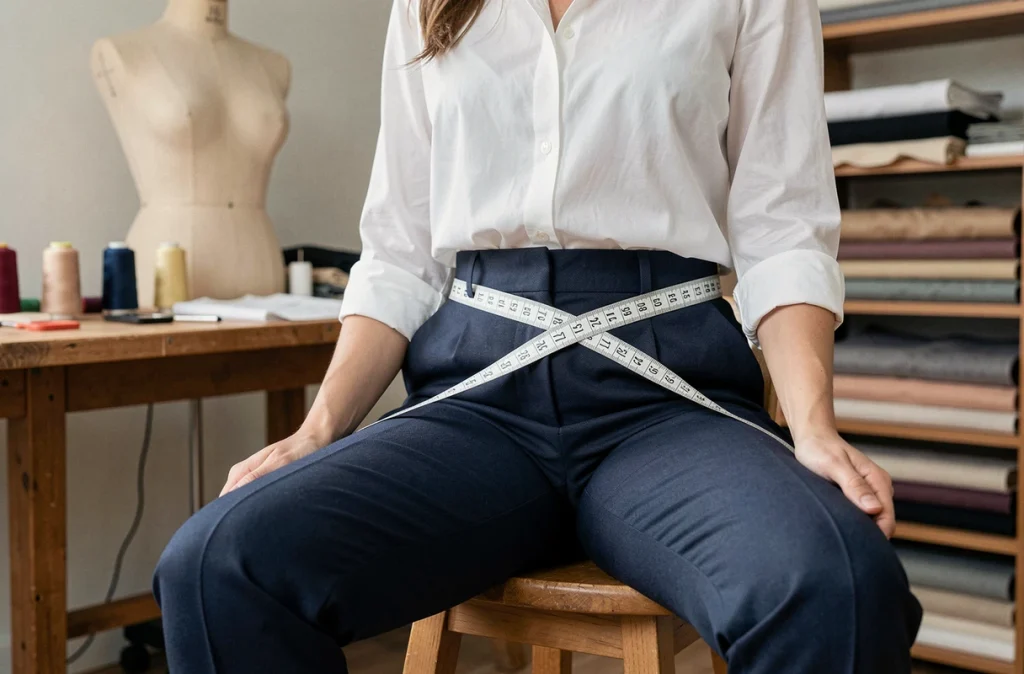
Taking measurements with a measuring tape: a reliable method
The accuracy of the measurements conditions everything else. A positioning error of the measuring tape by two centimeters is enough to distort the correspondence with any chart.
The three measurements to take
- Bust circumference: measuring tape horizontal across the fullest part of the bust, without compressing or leaving it loose. Measure at the end of a normal exhalation, arms at your sides.
- Waist circumference: at the narrowest part of the torso, generally between the last rib and the top of the iliac crest. Locate this narrow part by leaning sideways: the natural skin fold indicates the waistline.
- Hip circumference: at the widest point of the hips, feet together, measuring tape strictly parallel to the ground. Pass the tape over the buttocks without pulling it too tightly.
We frequently observe a mistake: measuring the waist circumference at the level of the navel. In most women, the navel is located below the actual waistline, which gives a measurement that is two to four centimeters higher and distorts the correspondence with the charts.
Measurement conditions
Take your measurements in thin underwear, standing, in front of a mirror to check the horizontal position of the tape. The morning on an empty stomach remains the most reproducible time. Note your figures to the nearest centimeter, without rounding.
Waist circumference size 38 and health thresholds: two distinct logics
The clothing chart and medical recommendations do not measure the same thing. A waist circumference of 68 cm corresponding to a commercial size 38 is well below health alert thresholds. The High Authority of Health (HAS) sets a cardio-metabolic vigilance threshold at 88 cm waist circumference for women.
This threshold does not define an aesthetic ideal. It signals the level at which the accumulation of visceral fat statistically increases cardiovascular and metabolic risk. Between 68 cm (commercial size 38) and 88 cm (HAS threshold), there is a wide range where health is not at stake.
An additional indicator is gaining clinical use: the waist-to-height ratio. A value below 0.5 is associated with a low metabolic risk, regardless of the clothing size worn. This ratio has the advantage of adapting to all statures without a correspondence table.

Women’s measurements and variations in morphology: why size 38 is not enough
Two women both wearing a size 38 can present very different silhouettes. The distribution of volume between bust, waist, and hips determines morphology much more than clothing size.
In modeling, several types of statures and shapes are distinguished:
- A silhouette in A (hips wider than shoulders): the hip measurement exceeds the standard size 38 chart, but the waist measurement corresponds.
- A silhouette in H (shoulders, waist, and hips aligned): the differential between waist and hip measurements is small, which alters the fit of fitted garments.
- A silhouette in V (shoulders wider than hips): the bust measurement may require a size 40 on top while the bottom remains a size 38.
Wearing a single size does not reflect a single measurement. The practice of buying different sizes for the top and bottom (bi-sizing) concerns a significant proportion of women and is not abnormal from a morphological standpoint.
Guides that present “perfect” measurements as a goal to achieve confuse a construction tool with a body norm. The waist measurement of a sewing pattern aims to fit a garment to a body, not to define what that body should measure.
The only relevant question remains practical: do your actual measurements correspond to the chart of the brand you are buying? If the measured waist circumference deviates by more than two centimeters from the indicated value for a size 38, move to the adjacent size or look for a cut better suited to your shape. The garment should fit the body, not the other way around.