You’re going on a trip and you don’t want to take your main bank card. Or your teenager needs a payment method, but you’d prefer to keep control over the amount spent. In both situations, the prepaid card meets a specific need: to pay without linking the card to a traditional checking account.
Electronic payment account: the mechanism that no one details
Most guides describe the prepaid card as a card “that you reload.” This is accurate, but incomplete. Behind every prepaid card is a payment account distinct from a checking account. This account is hosted by a licensed payment institution, not by a traditional bank.
In practice, when you purchase a prepaid card from a tobacconist or online, the issuer opens this payment account in your name. The balance you load is stored there. Each transaction (in-store purchase, online payment, ATM withdrawal) deducts from this balance, just like a checking account, but without an overdraft facility.
Why does this distinction matter? Because a payment account does not offer the same guarantees as a bank account. It is not covered by the deposit guarantee fund in the same way. If you store significant amounts there, you are taking a risk that many users are unaware of. To learn everything about the prepaid card and its technical subtleties, it’s better to gather information before loading several hundred euros at once.

Prepaid card and identification rules: what has changed recently
Have you noticed that some prepaid cards have very low purchase limits? This is not a commercial choice. It is a regulatory requirement.
European rules to combat money laundering and the financing of terrorism have tightened identification requirements (KYC) on prepaid cards. The trend is clearly towards a reduction in the possibilities for completely anonymous use. Beyond certain top-up or payment thresholds, the issuer must verify your identity with procedures comparable to those of a simplified bank account.
In practice, this means two things:
- A card purchased without providing identification will have very limited payment and top-up limits, often insufficient for regular use
- To increase these limits, you will need to provide identification, proof of address, and sometimes even a verification selfie
- So-called “anonymous” cards hardly exist anymore for significant amounts in Europe
If you’re looking for a prepaid card to maintain your privacy during online purchases, be aware that the actual level of privacy directly depends on the amount you plan to load.
Virtual or physical prepaid card: two different uses
The physical prepaid card, the one you slip into your wallet, remains the most well-known. It can be used in stores, online, and at ATMs, on Visa or Mastercard networks depending on the issuer.
The virtual prepaid card is more recent. It comes in the form of a card number, an expiration date, and a security code, without any plastic support. Some specialized providers offer these virtual prepaid cards without linking a bank account, with a balance that you reload yourself.
When to prefer the virtual card
The main use remains online payment. You create a card, load it with the exact amount of your purchase, and pay. If the merchant site suffers a data breach, the information from your main card is not exposed. This is a security use, not a convenience one.
When the physical card is preferable
For traveling abroad, ATM withdrawals, or payments at merchants who do not accept mobile contactless payments, the physical card is the only option. It also works as a budget management tool for a teenager: the parent loads a defined amount, and the teen cannot spend more.
Hidden fees of prepaid cards: items to check before buying
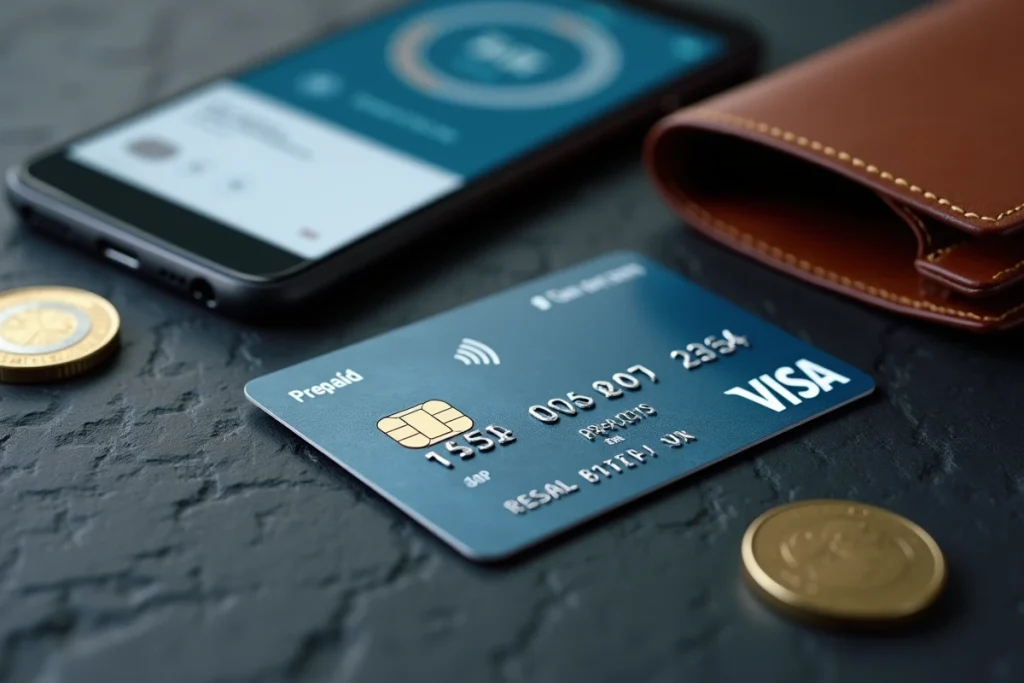
The purchase price of the card is just the visible part. The fees that actually reduce your balance are elsewhere.
- Reloading fees: some issuers charge a percentage on each reload, especially by credit card or in cash at a tobacconist
- Inactivity fees: if you do not use the card for several months, monthly fees may be automatically deducted from your balance
- Withdrawal fees: ATM withdrawals are often charged per transaction, and even more so abroad
- Conversion fees: any payment in a currency different from that of the card incurs a currency exchange commission, sometimes higher than that of a regular bank card
A simple reflex before choosing: compare the total cost of use over three months rather than just the purchase price. A card costing a few euros can end up being much more expensive than a premium card if reloading and withdrawal fees accumulate.
Prepaid card for payments abroad: a nuanced choice
Many travelers choose a prepaid card to avoid traveling with their main bank card. The idea is good in principle. In case of loss or theft, only the loaded balance is exposed.
The trap comes from the foreign currency conversion fees. Depending on the issuer, the exchange commission can negate the financial advantage of the prepaid card. Before leaving, check if the card offers payments in local currency without extra cost, or if each transaction outside the euro zone generates a fee.
For a stay in the euro zone, the prepaid card remains a practical payment method without unpleasant surprises. Outside the euro zone, always compare with the conditions of your usual bank.
The prepaid bank card is neither a gadget nor a complete substitute for a bank account. It is a niche tool, suitable for specific uses: budget control, protection during online purchases, a payment method for a minor or a cautious traveler. Choosing the right card involves first identifying the use, then checking the actual fees, not the other way around.