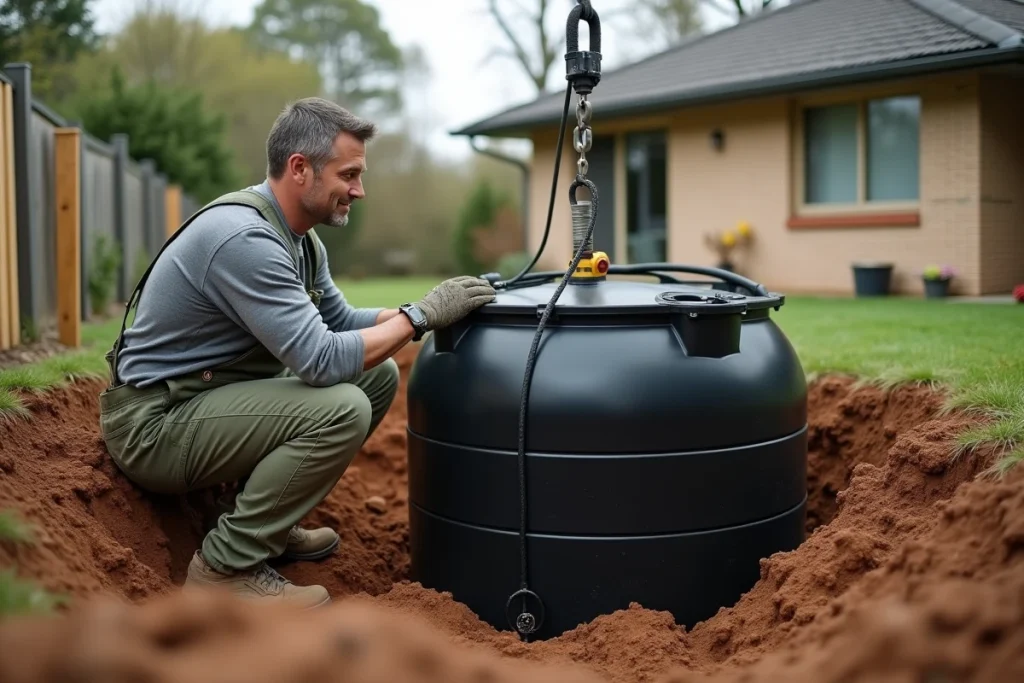
Between an above-ground tank placed in a corner of the garden and a buried tank under the lawn, the differences are not limited to storage volume. Water temperature, pH, shelf life, maintenance constraints: several technical parameters distinguish these two options. Comparing this data helps to understand why the buried tank is preferred in certain contexts, and not just for aesthetic reasons.
Buried tank or above-ground: a comparison of storage performance
The choice between these two types of tanks is based on measurable criteria. The table below summarizes the most significant differences based on available data.
| Criterion | Above-ground tank | Buried tank |
|---|---|---|
| Current capacity | 200 to 1,000 liters | Several thousand liters (up to 10,000 liters and more) |
| Thermal stability | Subject to seasonal variations, possible freezing in winter | naturally stable temperature all year round |
| Risk of algae proliferation | High (exposure to light and heat) | Very low (constant darkness and coolness) |
| pH of stored water (concrete tank) | Not applicable (plastic) | Neutralization of acidity by calcium carbonates |
| Visible ground footprint | Yes | None |
| Water shelf life | Several weeks before degradation | Several months under optimal conditions |
When considering the installation of a buried rainwater harvesting tank, these performance differences guide the project’s sizing. An above-ground tank remains relevant for occasional watering, but as soon as the uses include toilets or washing machines, the stability of the water becomes a determining factor.
pH and water quality: the advantage of buried concrete over polyethylene
Rainwater is naturally acidic, with a pH between 5.5 and 6. Stored in a polyethylene tank (the standard material for above-ground tanks), it retains this acidity. In a buried concrete tank, the calcium carbonates present in the walls gradually bring the pH back towards neutrality.
This chemical correction has two practical consequences. It reduces bacterial growth during prolonged storage. It also limits odors that occur when water stagnates in a plastic tank exposed to heat.
For indoor uses (feeding toilets, connecting to washing machines), water close to neutrality reduces scaling and deposits in the pipes. This technical point is rarely mentioned in buying guides, which focus on volume and price.
Tank material and lifespan
Concrete withstands ground pressures and soil movements better than a buried polyethylene tank. However, its weight requires more significant excavation and accessible delivery.
High-density polyethylene tanks also exist in a buried version. They are lighter, less expensive to transport, but their lifespan remains shorter than that of concrete over decades of use.
Maintenance of a buried tank: regulatory obligations and actual frequency
The maintenance of a buried rainwater harvesting tank is not limited to an annual check. Regulations require specific verifications, and neglecting them directly affects water quality and system longevity.
- Sediments and sludge accumulate at the bottom of the tank. A complete cleaning (draining, dredging) must occur regularly to prevent gas formation and degradation of the stored water.
- The upstream filtration system (gutter filter, pre-tank filter) requires checking at least twice a year, before and after the heavy rainfall season.
- The overflow and connection to the sewage system must remain functional. A blocked overflow can cause water to back up to the roof or saturate the ground around the tank.
- A declaration at the town hall is mandatory for any rainwater harvesting installation for indoor use, with mention in the housing’s sanitary record.
Allowing sediments to accumulate degrades the water as much as open tank storage. The qualitative gain of a buried tank disappears if maintenance is not ensured.
Tank sizing: roof area and local rainfall
Installing an oversized or undersized tank amounts to wasting money in both cases. The calculation of useful capacity is based on two variables: the connected roof area and the annual rainfall of the municipality.
Connecting gutter, pipe, and tank
The collecting roof area is measured in horizontal projection. A sloped roof of 80 m² does not collect the same amount of water as a flat roof of the same footprint, as the runoff coefficient varies according to the material (tiles, steel sheet, slate). The steel sheet offers the best runoff coefficient among common coverings.
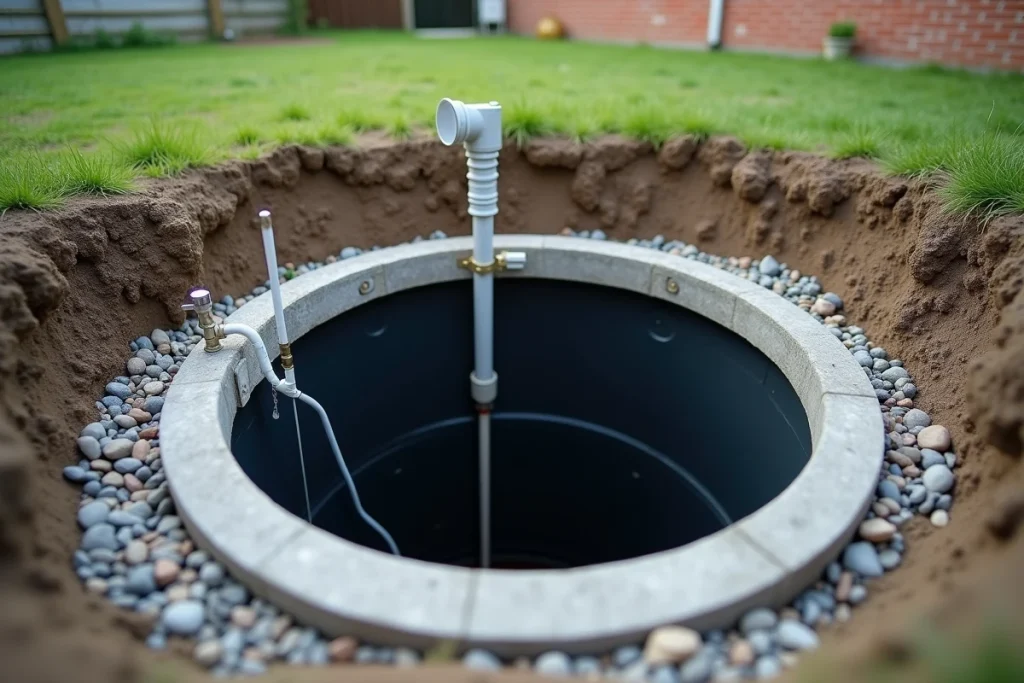
The connection between the gutter and the tank goes through a filtering collector installed on the downspout. This filter retains leaves, moss, and debris before they reach the tank. Without this first stage of filtration, sediments accumulate faster and cleaning becomes more frequent.
Adapting volume to actual uses
A modest-sized garden with simple summer watering does not justify a tank of several thousand liters. Conversely, a house connecting toilets and washing machines to rainwater needs a storage volume capable of covering dry periods without supplementing from the potable network.
The correct sizing aligns expected consumption with actual collection capacity. Overestimating rainfall or underestimating uses leads to a slower return on investment than expected.
The buried tank stands out for its ability to maintain stable, neutral, and usable water over long periods, provided that sizing and maintenance are followed. The concrete material and burial address the two structural weaknesses of above-ground storage: thermal instability and persistent acidity. It is these technical parameters, more than just the space-saving aspect, that justify the investment in a buried system.