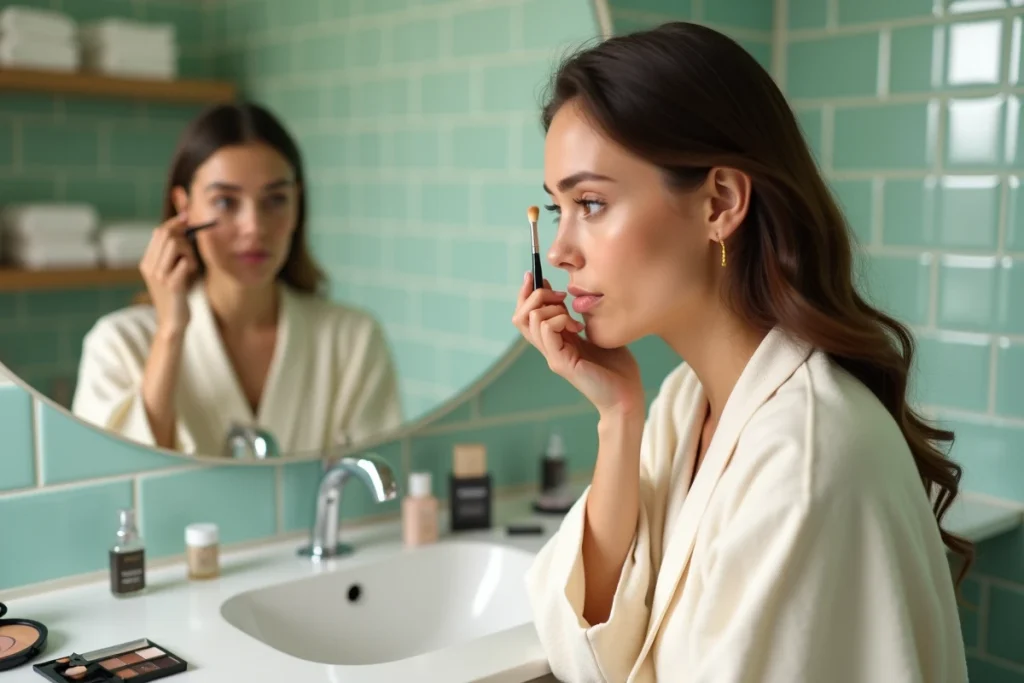
Applying eye makeup convincingly does not require a collection of palettes or years of practice. The difference between a messy result and a clean look often comes down to three specific variables: the choice of textures, the order of application, and the area where light is placed. This article compares the most common approaches to identify those that produce a visible result with the least effort.
Lifting V-shape or classic gradient: two methods face to face
The majority of tutorials teach the gradient of eyeshadows on the mobile eyelid, with a light color in the inner corner and a darker shade in the crease. This technique requires mastering blending, which can be challenging for beginners.
A different approach is gaining traction: the V-shape at the outer corner of the eye, popularized by makeup artist Tommy. The principle involves applying a medium shade in an inverted V shape at the outer corner, followed by a liner that extends this V towards the temple. Concealer is then used to clean up the edges for a graphic and lifting effect, without complex blending.
| Criterion | Classic gradient (banana) | Lifting V-shape |
|---|---|---|
| Number of eyeshadows needed | At least 2 to 3 | 1 is enough |
| Brushes required | Blending brush + precision brush | Brush or finger + liner |
| Average execution time | Longer (progressive blending) | Faster (direct line) |
| Difficulty for beginners | Medium to high | Low |
| Main visual effect | Depth and volume | Lifting look, enlarged eye |
The gradient remains the reference for elaborate looks or evening makeup. In contrast, the V-shape produces a cleaner result with less material, making it a more accessible starting point to learn how to easily apply eye makeup before moving on to more advanced techniques.
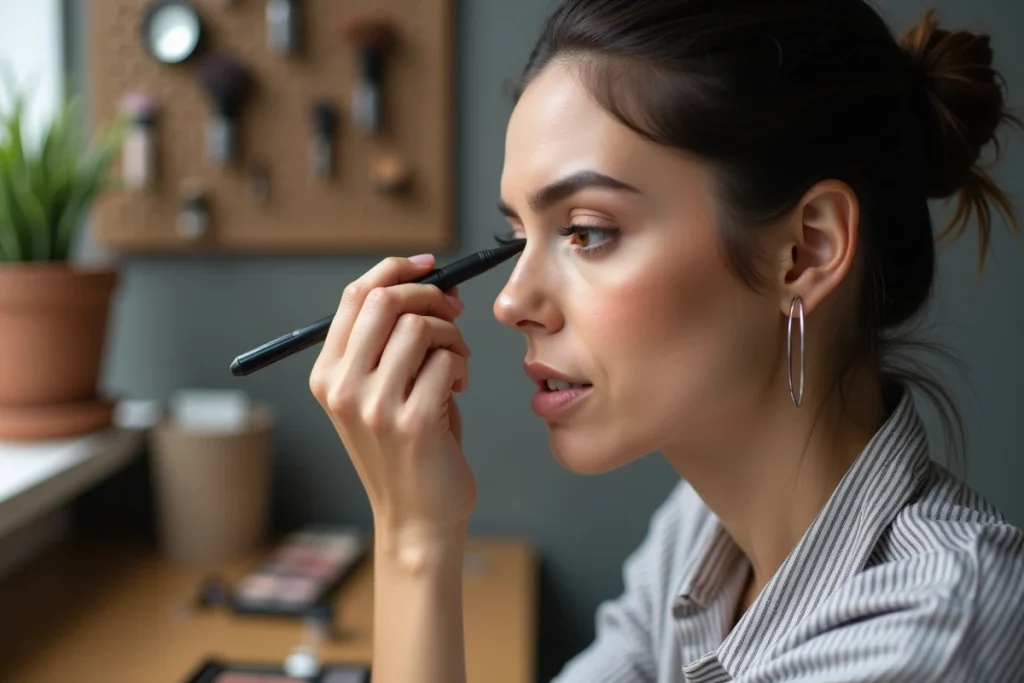
Base and concealer: the preparation that changes the final result
Applying eyeshadow directly on a bare eyelid is the most common mistake. The skin’s texture absorbs pigments within a few hours, causing colors to shift or disappear. Two products solve this problem without weighing down the routine.
Eyeshadow primer and color longevity
A primer (or setting base) creates a smooth and slightly tacky surface. Eyeshadow lasts significantly longer on a prepared base than on a bare eyelid, even with budget formulas. A pea-sized amount is enough, spread with a finger over the entire mobile eyelid up to the brow bone.
Strategic concealer to open the eyes
Concealer is not just for covering dark circles. When applied in small amounts to the inner and outer corners of the eye, it acts as a shape corrector. It cleans up the makeup contours and creates a bright contrast that visually enlarges the eye.
Avoid spreading concealer all over the area under the eye: a whitish halo draws attention to bags instead of camouflaging them. A dot in the inner corner and a fine line under the brow are sufficient.
Eyeshadows and textures: adapting the product to the eyelid skin
The choice of eyeshadow depends less on the brand than on the texture. Each type of formula behaves differently on the eyelid, and this behavior influences the result as much as the chosen color.
- Cream or stick eyeshadows: they are applied with the finger, blend easily, and are suitable for beginners. Their wear is decent on a prepared base, but they can migrate into the eyelid folds if the skin is oily.
- Pressed powder eyeshadows: they offer more shade options and layer well. They require a suitable brush and a blending motion to avoid harsh lines.
- Liquid eyeshadows or loose pigments: more intense color, but tricky to apply. They are suitable for elaborate looks, not for quick everyday makeup.
For simple and reproducible eye makeup, a neutral cream eyeshadow on the mobile eyelid and a pencil along the lashes form the most reliable combination. Warm shades (golden beige, taupe, rose brown) work on most iris colors without requiring advanced color mastery.

Mascara and pencil: finishing touches that structure the gaze
Mascara is the product that has the most visual impact relative to the effort involved. A single coat on the upper lashes is enough to frame the eye and add intensity to the gaze.
Applying mascara without clumps
Wiping excess product off the wand before application significantly reduces the risk of clumps. Starting from the root of the lashes and moving up in a slight zigzag separates the lashes while applying the product evenly. Lower lashes only need mascara for a bold look: applying it daily often weighs down the gaze.
Pencil or eyeliner: which line for a natural result
Kohl pencil, blended along the upper lash line, gives a “light smoky” effect accessible to everyone. A fine line placed at the lash line visually thickens the lash fringe without creating a graphic line that is difficult to achieve. Felt-tip eyeliner is better for a clean line but is less forgiving of shakes.
For sensitive eyes, prefer ophthalmologist-tested formulas and avoid drawing on the inner waterline, which can irritate mucous membranes in some individuals.
Eyeshadow colors according to eye color: practical guidelines
The color wheel provides a simple guideline: complementary colors to the iris enhance the gaze. Here are the most reliable associations.
- Blue eyes: copper, orange, sienna shades. Blue eyeshadows create a monochrome effect that flattens the gaze.
- Green eyes: plum, burgundy, copper pink tones. Green on green cancels out contrast.
- Brown eyes: the widest palette. Golds, olive greens, and deep blues all create interesting contrasts.
- Black eyes: metallic shades (bronze, silver, champagne) capture light and prevent a too-closed look.
These guidelines are not absolute rules. A matte taupe eyeshadow works on all iris colors and is a reliable staple in a makeup kit reduced to a few products.
Eye makeup relies more on eyelid preparation and product placement than on quantity. A primer, a neutral eyeshadow, a pencil, and mascara cover most everyday situations. The rest, multiple palettes and advanced techniques, only make sense once these basics are mastered.