
During a real estate sale, the boundary between what remains in the property and what goes with the seller often generates frequent disagreements. The Civil Code distinguishes between movable and immovable property by destination, but this classification does not cover all concrete cases. This article analyzes the most common friction areas between buyer and seller, relying on recent jurisprudential developments.
Immovable by destination and movable property: comparative table
The legal qualification of an object determines whether it should remain in the sold property or not. The Civil Code classifies as immovable by destination any element that is permanently fixed to the building, sealed, or specially adapted for the location. A movable property, on the other hand, can be moved without damaging the structure.
| Element | Usual classification | Must remain in the property |
|---|---|---|
| Built-in fireplace | Immovable by destination | Yes |
| Integrated kitchen (fixed furniture) | Immovable by destination | Yes |
| Boiler, ventilation system, air conditioning | Immovable by destination | Yes |
| Parquet flooring, moldings, woodwork | Immovable by destination | Yes |
| Mirror sealed to the wall | Immovable by destination | Yes |
| Custom fitted wardrobe | Immovable by destination | Yes |
| Light fixture fixed to the ceiling | Gray area (see below) | According to the agreement |
| Chandelier hung from a hook | Movable property | No |
| Curtains and non-sealed rods | Movable property | No |
| Freestanding appliances (refrigerator, washing machine) | Movable property | No |
This table covers the most common situations. In practice, it is the mention in the sales agreement that decides. Knowing precisely what must be left in the house during the sale avoids most disputes after signing.

Light fixtures, kitchens, and mirrors: disputes on the rise
Disputes focus on objects that the law has difficulty qualifying. Is a light fixture screwed to the ceiling a fixed element of the electrical circuit or a removable decorative accessory? The answer depends on the method of attachment and what the buyer saw during the visit.
The case of fixed light fixtures
The sockets and wiring are part of the electrical installation and remain in the property. However, a chandelier simply hung from a hook is a movable item. The gray area concerns light fixtures screwed or integrated into the false ceiling: their removal leaves a hole or an apparent defect, which fuels buyer claims.
The most effective precaution is to list each light fixture in the agreement with the mention “included” or “not included.” Without this mention, the buyer may consider that everything they saw during the visit is part of the transaction.
Integrated kitchen and built-in appliances
Kitchen furniture fixed to the walls is considered immovable by destination. The sealed countertop, sink, and connected extractor hood therefore remain in the property. Built-in appliances pose a distinct problem: an oven integrated into a custom niche is often considered inseparable, while a dishwasher simply slid under the countertop is not.
When the seller removes a kitchen element visible during visits, the buyer has recourse based on the obligation of conformity.
Mirrors and decorative woodwork
A mirror glued or screwed to the bathroom wall is immovable by destination. A mirror placed on a piece of furniture is not. The difficulty arises when the removal of the mirror damages the tiling or plaster: the seller must then restore the wall or compensate the buyer.
Obligation of conformity: what jurisprudence reinforces
The Court of Cassation reminded in 2023 that the seller’s obligation of conformity extends to the technical equipment left in the property. This decision concerned air conditioning installations generating noise nuisances above regulatory thresholds. The third civil chamber ruled that the seller must deliver equipment compliant with current standards, without the buyer having to prove fault.
This position has direct practical consequences. A heating system, ventilation system, or air conditioning left in the property must function and comply with regulations. If not, the buyer can demand compliance or a price reduction, even after signing the authentic deed.
- Check the proper functioning of each technical equipment before the sale, especially the boiler and air conditioning
- Keep maintenance invoices and certificates of conformity to produce in case of dispute
- Explicitly mention in the agreement the operational status of the installations left
- Have a complementary diagnosis done if any equipment is over ten years old
This jurisprudence strengthens the buyer’s position against defective equipment presented as functional during the visit.
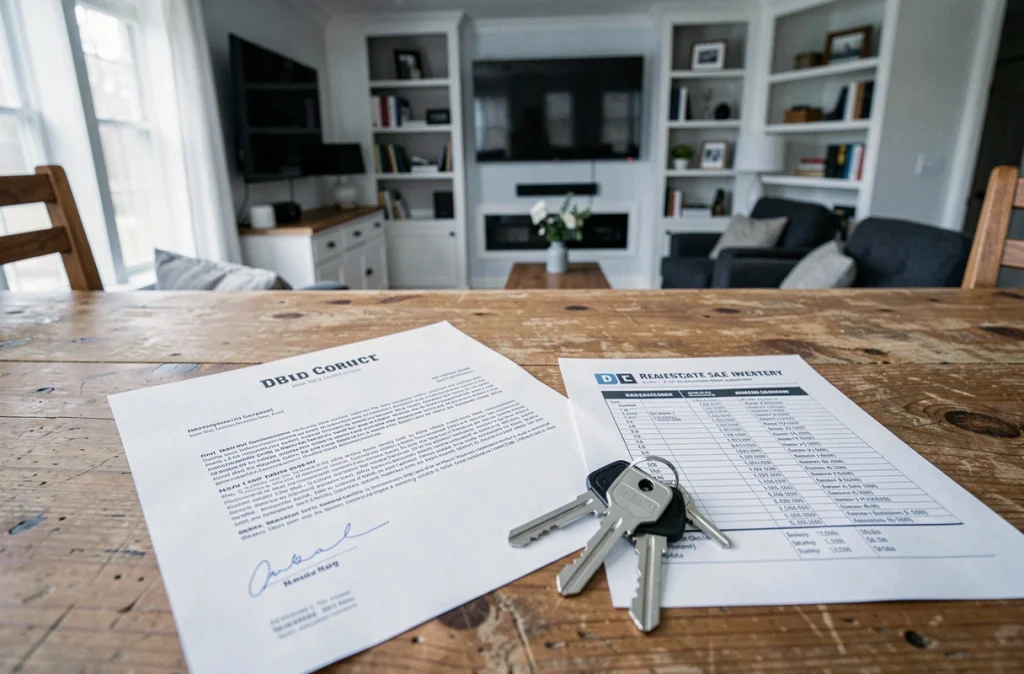
Role of the sales agreement and the notary in the list of included elements
The sales agreement is the document that secures the transaction on this point. The notary usually attaches a detailed list of the elements included in the sale price. This list mentions fixed equipment, any furniture sold in addition, and their separate valuation.
The separate valuation of furniture has a tax advantage: the movable elements included in the sale can be deducted from the taxable base for transfer duties, provided that their estimation is realistic and justified. The notary verifies the consistency of this list with the overall price of the transaction.
Without a list attached to the agreement, the default rule applies: everything that is immovable by destination remains, everything that is movable goes with the seller. The problem arises when an element falls between the two categories and the buyer saw it during the visit. The visit creates a legitimate expectation that the agreement must explicitly confirm or deny.
Drafting this list takes time, but it provides the best protection for both parties. A seller who removes a listed item exposes themselves to a claim for non-delivery. A buyer who demands an unlisted item generally has no legal leverage.